Landscaping Marketing
How to Get Landscaping Customers for the Work You Want
To get landscaping customers, start by making the work you want easy to recognize. A homeowner looking for weekly lawn care has a different buying decision from someone planning a patio. If your website presents both as a vague list of “outdoor services,” neither visitor gets much help.
Choose the services and locations that make sense for your crew, then make your website, project photos, and inquiry process support those choices.
Define a useful customer before chasing more traffic
Write down the jobs you want more of, the areas you can serve efficiently, and the work you do not take. For recurring maintenance, route density may matter. For a larger hardscape project, site access, budget, and scheduling may matter more.
Your homepage should introduce the business, but the service pages can make these distinctions. Explain whether you offer recurring care, one-time cleanups, design and installation, or tree services. Do not imply you provide every outdoor trade simply to appear in more searches.
This is also useful offline. A referral partner who knows that you focus on patio installation can send a more suitable prospect than one who only knows you “do landscaping.”
Make project photos answer a question
Before-and-after photos are useful when a visitor can understand what changed. Add a short description of the customer’s objective, the scope, and the completed work. Use the actual project location only with appropriate permission, and avoid exposing a customer’s precise address unnecessarily.
For a patio, show the overall layout and details such as steps or transitions. For garden work, show the planting area and the finished view. For maintenance, explain the service performed rather than suggesting that every transformation involved a full redesign.
Do not pair someone else’s stock photo with wording that implies it is your completed job. When you have limited photography, a smaller honest gallery is a better starting point.
Learn from three different outdoor-service websites
These are websites ZDM has built. They illustrate presentation choices, not a claim that a particular design produced a measured number of customers.
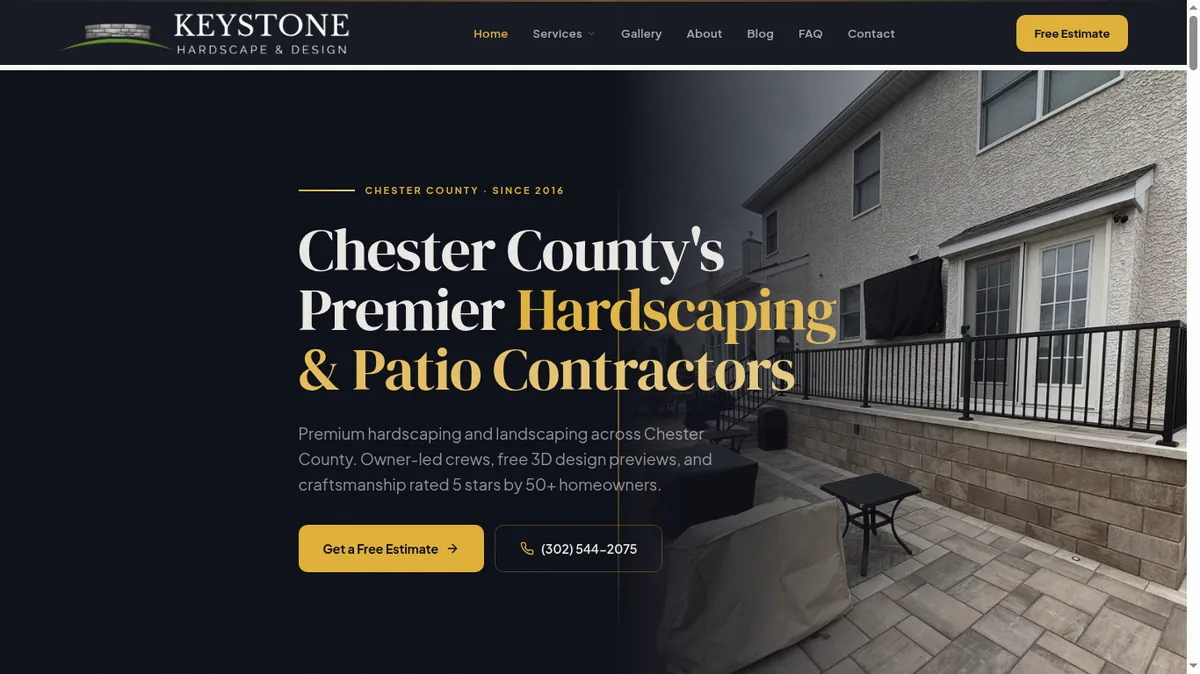
- Keystone Hardscape & Design: Project imagery and dedicated hardscaping information give a visitor ways to explore a larger outdoor project. See the Keystone case study for the website scope.
- Green Flowers Landscaping: Landscaping and hardscaping information connects the work to a quote-request path.
- 1-2 Tree Gone: Tree-service and landscaping information helps distinguish the services before a visitor requests a quote.
The principle is to organize around the decisions your customer has to make. A tree-service inquiry and a landscape-design inquiry should not require a visitor to decode the same generic pitch.
Match local visibility to your actual coverage
Keep your business information consistent and your Google Business Profile accurate. Google’s local-ranking guidance explains that distance is one factor alongside relevance and prominence. Adding a distant town to a website does not ensure visibility there.
Use service-area content to help customers determine whether you can take the job. Add local project context when you have it. Avoid large collections of near-identical town pages that contribute nothing beyond a changed location name.
Seasonal content should also reflect real availability. Update the site when a service opens or closes for the season. An old promotion that your crew can no longer fulfill creates the wrong kind of inquiry.
Ask enough to qualify the project
A quote form can start with name, contact information, job location, service needed, and a short project description. Optional photos and a preferred timing field can help you prepare a useful response.
For design-and-build work, a budget range may be useful if you explain why you ask and offer an “unsure” option. For routine maintenance, property details and location may be more immediately useful. Do not make every prospect complete the same long form.
Review which inquiries turn into work you want. If most requests are outside your coverage or below your actual minimum scope, make those boundaries clearer before spending more on promotion.
Start by improving one service page and pairing it with relevant project photos. See our landscaping website service for real examples and the available website scope, or tell us about your current site.