AI Search Guide
How to Improve Your Website’s Visibility in AI Search
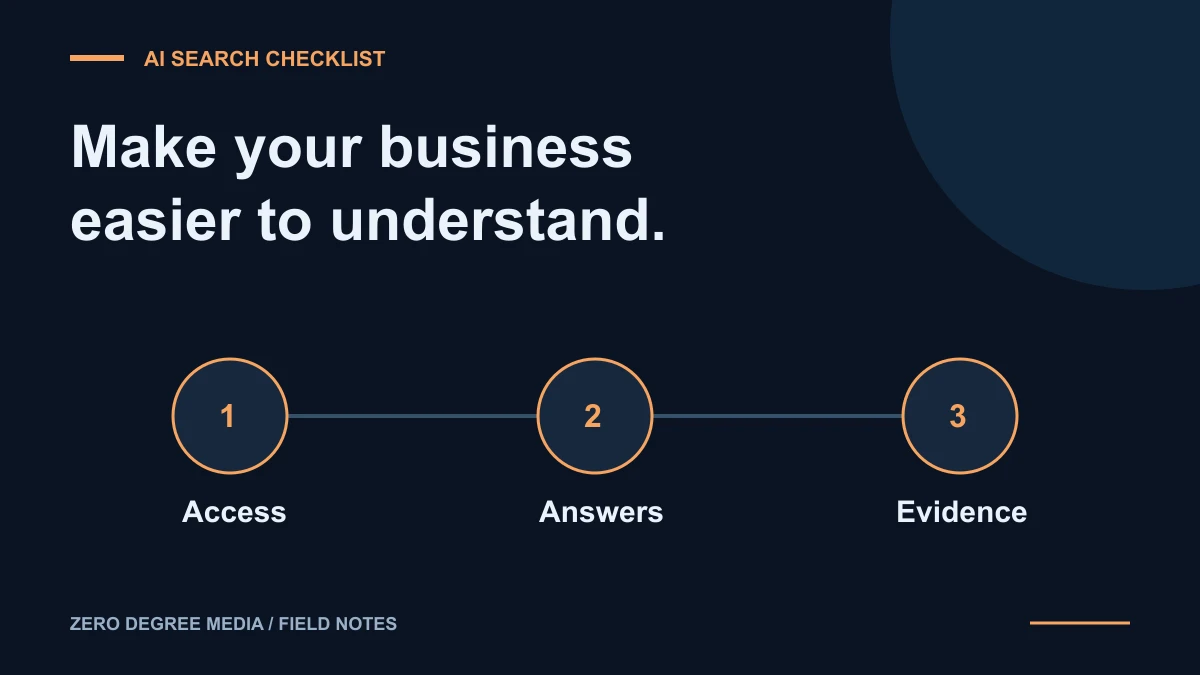
Improving your website’s visibility in AI search starts with making your business easy to understand and your information worth referencing. A useful audit checks what a system can access, what a customer can learn, and what evidence supports your claims.
Use this checklist to organize the work. It is a practical review process, not a formula that guarantees a recommendation from ChatGPT, Google or another platform.
1. Choose the customer questions that matter
Start with the questions people ask before buying your service. A contractor might hear “Do you repair an existing deck?” or “What information do you need for a paving estimate?” A salon might hear “Can I book a trial before my wedding?”
Choose questions tied to work you actually want. Record the question, the page that should answer it, and what the visitor should do next. A page can answer several related questions; you do not need a separate article for every wording variation.
For a local service business, prioritize services, coverage areas, project examples and the estimate process before publishing a large collection of broad AI articles.
2. Check whether your important pages are accessible
Open each priority page on a phone and follow its links from your homepage. Check that useful descriptions appear as readable text and that the page loads without requiring a login. Review indexing and crawler controls with whoever maintains the site.
Platform rules differ. Our ChatGPT Search guide explains the distinction between search access and training controls. Our Google AI Overviews guide covers Google’s eligibility requirements. A blocked page needs a technical investigation; it does not automatically need a complete redesign.
Keep a record of the exact page and issue. “This service page is excluded from indexing” is actionable. “Our AI score is low” needs an explanation of how the score was calculated.
3. Make the business facts clear
Review your name, contact details, services, service areas and booking instructions across your site and the profiles you manage. Correct conflicts. Explain exceptions, such as a service available only in part of your normal coverage area.
Avoid adding towns where you do not work. A visitor should be able to determine whether you can help without interpreting vague claims about serving “the entire region.”
Where structured data is used, it should describe the visible business accurately. It is a way of organizing information, not a promise that an AI system will select it.
4. Turn vague claims into helpful answers
Replace “We deliver the best service” with information a customer can use: what is included, what affects the estimate, what happens after an inquiry, and where the service is available.
Put a direct answer near the question, then explain the limits. If the answer depends on material, property access or job size, say so. Our AEO guide gives a practical structure for doing this without turning every paragraph into a sales pitch.
5. Add evidence from real work
Publish project photographs you have permission to use, descriptions of what your team actually did, and honest details about constraints or decisions. A before-and-after story is more useful when it explains the problem and scope rather than simply labeling the result “amazing.”
Our contractor website examples show real sites instead of invented demonstrations. That same standard should guide your own content. Do not manufacture reviews, client names, performance results or AI citations to fill a page.
6. Measure the difference between visibility and business results
Keep separate records for a business mention, a linked citation, a visit from an AI service, and an actual inquiry. They are different events. A crawler visit in a server log does not prove that a customer saw your business.
When manually checking answers, save the question, platform, date and any linked page. Treat the result as a snapshot: answers can vary between searches and people. Compare traffic and inquiries over time rather than claiming success from one favorable response.
Our GEO guide explains what evidence to ask for when evaluating a paid service.
Choose one improvement and verify it
Start with the most useful missing answer or the most important inaccessible page. Make the change, verify that it is live, and record what changed. Then review whether visitors can find information and take the next step more easily.
Google’s AI search guidance does not require a special AI file or special schema to participate. The durable work is a site with accurate information, useful answers and evidence that belongs to your business.
If you need help turning this checklist into specific website changes, contact Zero Degree Media.